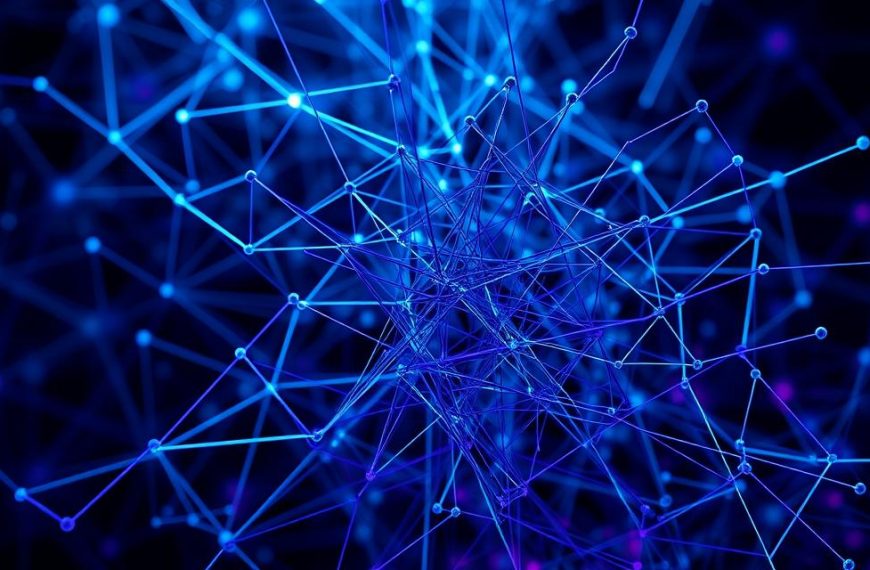


Modern technology owes much of its progress to computational systems that mimic biological processes. Among these, neural networks stand out as revolutionary tools reshaping industries from healthcare to finance. These systems, inspired by the human brain’s structure, organise layers of interconnected nodes to process data with remarkable efficiency.
At their core, neural networks form the foundation of deep learning frameworks. They analyse patterns through weighted connections and activation thresholds, improving accuracy as they ingest training data. This adaptability makes them indispensable in modern machine learning applications, where speed and precision matter.
Originally simple mathematical models, today’s architectures handle tasks that once required hours of human effort. From image recognition to predictive analytics, their ability to classify and cluster data drives innovation across sectors. Their evolution reflects broader advancements in computer science, merging theory with practical problem-solving.
This article explores how these systems operate, their role in artificial intelligence, and why they remain central to technological development. We’ll break down their layered structures, training processes, and real-world implementations – offering clarity on one of computer science’s most transformative concepts.
Introduction to Neural Networks and Deep Learning
Computational models inspired by biological thinking revolutionised how machines interpret complex patterns. These systems process information through layered nodes, mirroring the human brain‘s synaptic connections.
Core Principles of Adaptive Computing
At their essence, these models excel at identifying relationships within data without rigid programming. Their layered design enables progressive refinement – each iteration sharpens predictive accuracy through exposure to new inputs. This adaptability forms the backbone of modern AI systems used in voice assistants and fraud detection.
From Theory to Technological Breakthrough
The concept’s origins trace to 1944, when Warren McCullough and Walter Pitts demonstrated mathematical parallels between biological and artificial thinking. Key milestones include:
| Year | Development | Impact |
|---|---|---|
| 1957 | Frank Rosenblatt’s Perceptron | First trainable model |
| 1980s | Backpropagation algorithms | Enabled multi-layer learning |
| 2010s | GPU acceleration | Supported complex architectures |
Research faced multiple winters due to hardware limitations before graphics processors unlocked modern potential. Today’s systems owe their capabilities to this cyclical evolution of ideas and technology.
Understanding Neural Network Architectures and Layers
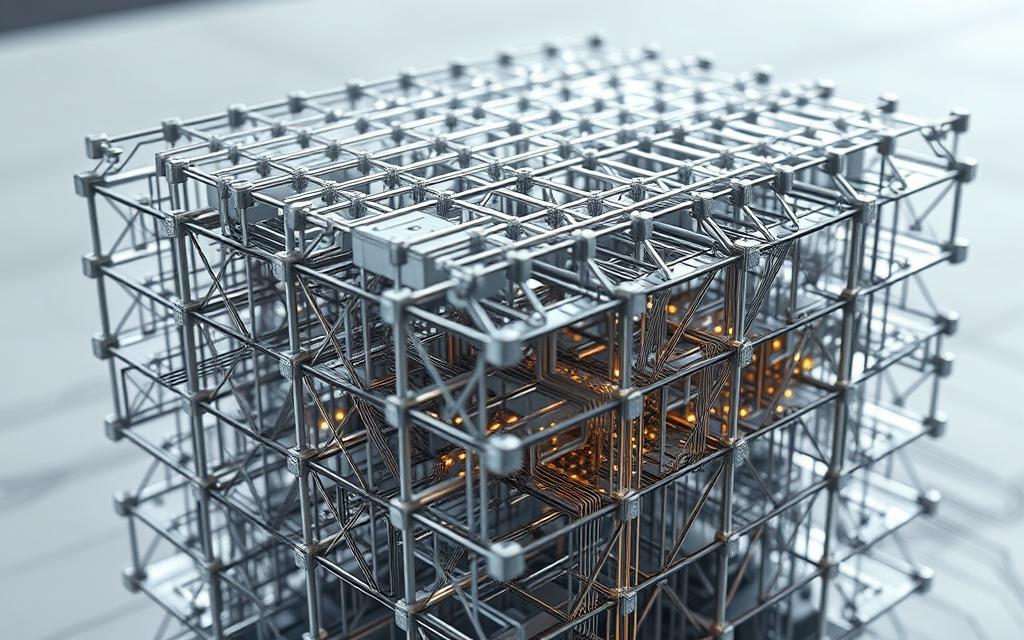
Modern computational designs rely on layered structures to interpret data systematically. These tiered frameworks process information through sequential stages, refining accuracy with each step. Their strength lies in directional data flow – from initial reception to final analysis – without cyclical dependencies.
Dissecting the Input, Hidden, and Output Layers
The input layer acts as the system’s reception desk. It accepts raw data like pixel values or sensor readings, distributing them through weighted channels. Each connection prioritises specific inputs, determining their influence on subsequent calculations.
Hidden tiers perform the heavy lifting. Multiple nodes here apply mathematical operations to incoming signals. They sum weighted inputs, compare totals against a threshold value, and decide whether to transmit results. This filtering creates progressive abstraction – turning basic features into complex patterns.
Final results emerge through the output layer. Whether identifying objects in photos or predicting stock trends, this stage converts processed data into actionable insights. The entire architecture remains scalable – adding more layers enhances its problem-solving capabilities.
Feed-forward designs ensure simplicity and efficiency. Data moves one way, layer by layer, avoiding feedback loops that complicate training. This streamlined approach powers everything from spam filters to medical diagnostics, proving adaptable across industries.
Exploring what are neural networks in deep learning
Advanced computational frameworks process information through layered architectures, forming the backbone of intelligent systems. These structures excel at translating raw inputs into meaningful insights – whether identifying faces in photos or predicting market trends.
Feedforward Networks and Backpropagation Explained
Feedforward architectures channel data unidirectionally, like assembly lines refining materials into finished products. Inputs pass through hidden layers where mathematical transformations occur, gradually extracting higher-level patterns. This simplicity enables efficient processing of complex datasets.
Training these systems relies on backpropagation – a method likened to error correction through reverse engineering. When outputs deviate from targets, the algorithm traces mistakes backward, adjusting connection weights using gradient descent.
“This iterative refinement process mirrors how humans learn from feedback,”
observes Dr. Eleanor Hughes, AI researcher at Cambridge.
Activation Functions and Learning Algorithms
Non-linear components like ReLU or sigmoid functions enable systems to model intricate relationships. Without them, even deep architectures would struggle with basic tasks like image classification.
Modern learning algorithms combine optimisation techniques to balance speed and precision. Adaptive learning rates adjust step sizes during gradient descent, preventing overshooting in complex error landscapes. Regularisation methods like dropout ensure models generalise well beyond their training data.
Through continuous exposure to labelled examples, these frameworks gradually minimise prediction errors. The result? Systems capable of diagnosing illnesses or optimising energy grids with human-like proficiency – yet operating at computational speeds.
Real-World Applications and Use Cases in AI
From voice-activated devices to medical diagnostics, intelligent systems reshape industries through adaptive data processing. These frameworks excel at tasks requiring rapid analysis – often outperforming human capabilities in speed and consistency.
Speech, Image Recognition, and Computer Vision
Voice assistants like Alexa demonstrate speech recognition’s evolution. Complex algorithms process accents and slang with 95% accuracy, responding in under two seconds. This efficiency stems from layered architectures analysing phonetic patterns.
In visual domains, image recognition tools identify tumours in X-rays faster than radiologists. Autonomous vehicles use similar systems to interpret road signs and pedestrian movements. Manufacturers employ these models for defect detection – spotting microscopic flaws in production lines.
Practical Implementations in Machine Learning
Retail giants leverage recommendation engines tracking browsing histories. Amazon’s systems predict purchases using neural networks that map user behaviour to product clusters. Social platforms apply this logic for photo tagging, recognising faces through convolutional layers.
Google’s search algorithms exemplify large-scale pattern recognition. By analysing trillions of data points, they deliver relevant results while filtering misinformation. Such implementations prove these architectures’ versatility across sectors – from finance to renewable energy management.
FAQ
How do neural networks mimic the human brain?
Inspired by biological neurons, these systems process data through interconnected layers. Signals travel from the input layer to the output layer, adjusting weights via training data. This mimics synaptic strengthening observed in cognitive processes.
What distinguishes deep neural networks from traditional models?
Depth matters. While basic models use few hidden layers, deep architectures employ multiple stacked layers. This hierarchy enables complex pattern extraction in tasks like speech recognition or computer vision, improving accuracy significantly.
Why are activation functions critical in these architectures?
Functions like ReLU or sigmoid introduce non-linearity, allowing networks to learn intricate relationships. Without them, even deep stacks would behave like single-layer models, failing to capture real-world data complexity.
How does backpropagation enhance learning algorithms?
This method calculates gradients by moving backward through layers. It adjusts weights by comparing outputs against ground truth, minimising errors. Frameworks like TensorFlow or PyTorch automate this process, optimising models efficiently.
Which industries benefit most from convolutional neural networks?
CNNs revolutionise fields requiring image processing. Healthcare uses them for MRI analysis, while automotive firms like Tesla apply them in autonomous driving systems. Retailers deploy CNNs for visual search tools and inventory management.
Can recurrent networks handle sequential data better than feedforward types?
Absolutely. RNNs process sequences—like text or time-series data—by maintaining memory through loops. Transformers, used in models like GPT-4, enhance this via attention mechanisms, enabling breakthroughs in natural language processing.
What challenges arise during model training?
Overfitting plagues complex architectures. Techniques like dropout layers or data augmentation combat this. Hardware limitations also surface, prompting use of GPUs from NVIDIA or cloud platforms like AWS SageMaker for scalable training.
How do reinforcement learning algorithms interact with neural networks?
Agents learn through trial and error, using networks to map states to actions. DeepMind’s AlphaGo exemplifies this, combining CNNs with policy networks to master Go. Reward signals guide weight adjustments, balancing exploration and exploitation.


 By
By