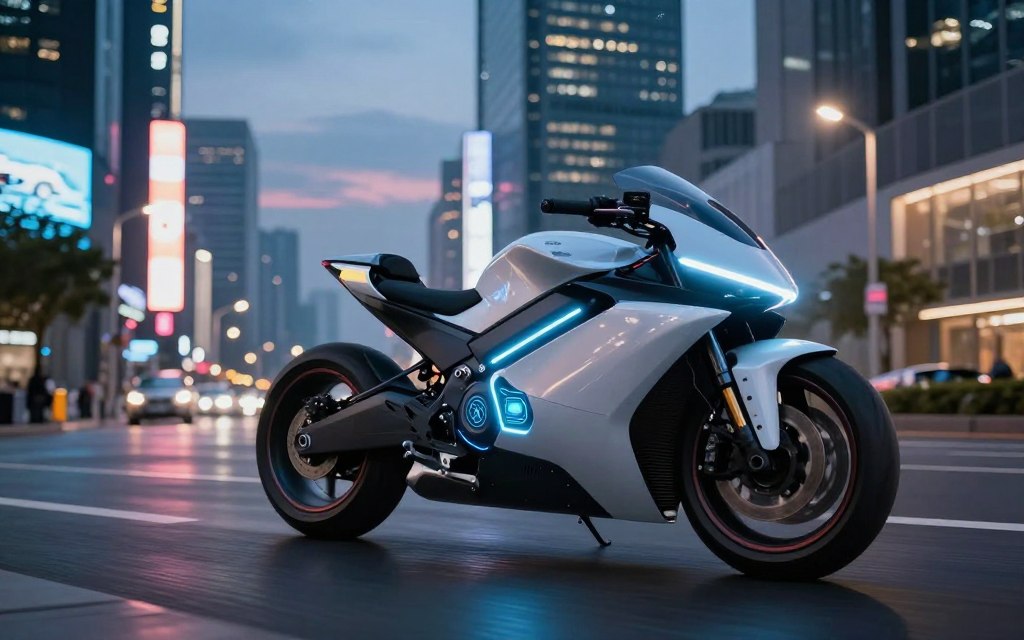

While self-driving cars get all the attention, a autonomous motorcycle is a real engineering wonder. It’s called the AI Ghost Rider. This bike moves on two wheels, all by itself, without a human.
The idea started with a groundbreaking project in the 2004 DARPA Grand Challenge. Engineer Anthony Levandowski created an early version. He showed that a self-driving bike wasn’t just a dream.
This article will break down the AI Ghost Rider technology. We’ll look at its challenges, uses, and what’s next for these riderless machines.
The Dawn of Autonomous Two-Wheeled Transport
The idea of a self-riding motorcycle started in a hot tub. This was a turning point where dreams met hard work. A small group, driven by a big dream, faced many challenges.
This era marked a big change. While cars were slowly becoming self-driving, motorcycles were also on the path to autonomy. The main hurdle was balance, something cars don’t face.
From Science Fiction to Engineering Reality
The first autonomous motorcycle idea came up in a hot tub. Anthony Levandowski, a student at the University of California, Berkeley, sparked it. They aimed to enter the DARPA Grand Challenge in 2004 with a robot bike.
Levandowski formed the ‘Blue Team’ in a garage. They had little money and sold burritos to fund it. This shows their DIY spirit and determination.
Their bike, GhostRider, was a modified Yamaha dirt bike. It didn’t win but showed two-wheeled autonomy was possible. The 2004 DARPA Grand Challenge entry changed the game.
Defining the Ghost Rider’s Mission
The GhostRider’s goal was to solve the balance problem. Unlike cars, motorcycles need to balance constantly. This required a new approach to making them self-driving.
The bike had to adjust its steering and throttle to stay upright. It was more than just going from point A to B. It had to sense its lean and correct it, like a human rider.
This task was complex, unlike the challenges faced by self-driving cars. The table below shows the main differences.
| Challenge Dimension | Autonomous Motorcycle (GhostRider) | Autonomous Car |
|---|---|---|
| Primary Stability | Dynamic; must actively maintain balance using steering, throttle, and gyroscopes. | Static; inherent stability from four-point contact. |
| Fall Recovery | Must have protocols to recover from a tip or fall, a frequent risk. | Not a primary design consideration. |
| Surface Sensitivity | Highly sensitive to road camber, gravel, and minor surface imperfections. | More tolerant of varied road surfaces. |
| Stopping State | Cannot come to a complete stop without a kickstand or support system. | Can remain stationary indefinitely without additional systems. |
| Payload Impact | Centre of gravity and balance are drastically affected by added weight. | Payload has minimal effect on core vehicle stability. |
Anthony Levandowski and the Blue Team started a new path in two-wheeled autonomy. They didn’t copy car tech but created something new. Their work set the stage for future research.
Deconstructing the AI Ghost Rider’s Core Systems
The Ghost Rider’s heart beats with three key systems: an AI brain, robotic actuators, and networked communication. Together, they turn sensor data into safe, precise movements on the road.
| Core System | Primary Function | Key Technologies & Components |
|---|---|---|
| The AI “Rider” | Perception, planning, and high-level decision-making. | Neural networks, path-planning algorithms, collision prediction models. |
| Autonomous Control Actuators | Physical execution of steering, throttle, and braking commands. | Servo motors, hydraulic cylinders, drive-by-wire systems. |
| V2X Communication | External networking with infrastructure and other vehicles. | Dedicated Short-Range Communication (DSRC), cellular-V2X (C-V2X). |
The Artificial Intelligence “Rider”
This is the motorcycle’s brain. It uses machine learning to process vast data from sensors. Unlike old systems, it understands the whole driving scene.
Path Planning and Dynamic Trajectory Calculation
The system doesn’t just follow a straight line. It plans a precise path hundreds of times a second. It considers the bike’s dynamics, road conditions, and even wind.
Early systems used simple paths. Now, they use neural networks trained on millions of miles. They adjust paths for obstacles or sudden changes in traffic.
Real-Time Decision Making and Hazard Response
When danger appears, the AI must act fast. It uses algorithms to predict and avoid collisions. These models often beat human instincts in tricky situations.
The AI weighs many options—swerve, brake, or speed up—choosing the safest one. This constant cycle of sensing, predicting, and planning is the heart of autonomous machine learning.
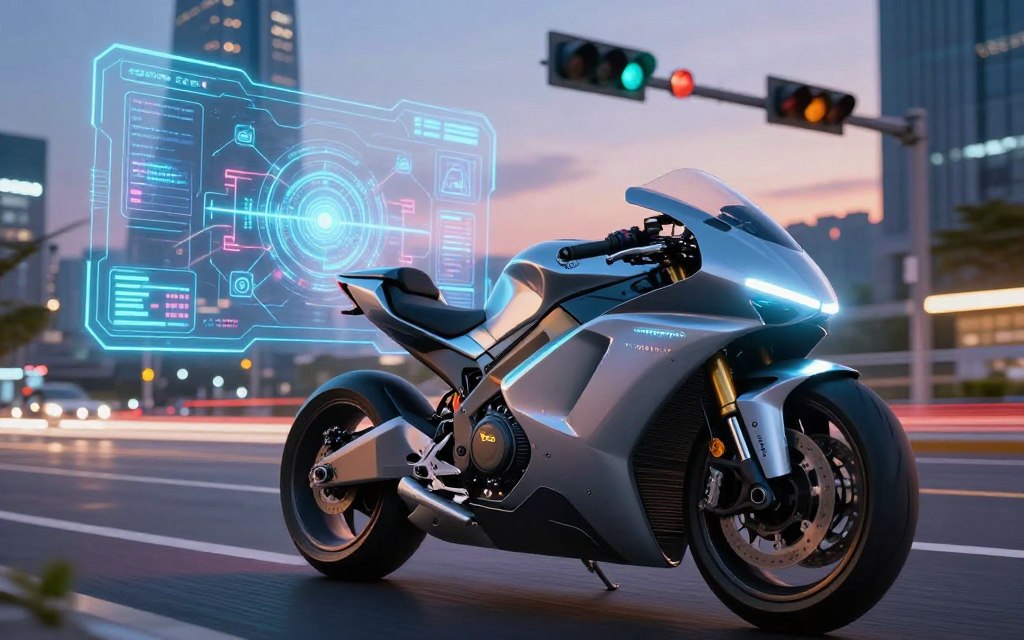
The Autonomous Control Actuators
The actuators are the motorcycle’s muscles. They turn digital commands into real actions. They must be quick, precise, and reliable.
Drive-by-wire technology controls the bike’s movements. Servo motors or hydraulic cylinders adjust the controls based on the AI’s plans. This allows for incredible speed and smoothness.
This control is key to making the AI’s plans real. It’s the final step in the motorcycle’s autonomy.
Vehicle-to-Everything (V2X) Communication
V2X communication lets the motorcycle see beyond its sensors. It exchanges data with traffic lights, other cars, and signs.
For example, a smart traffic light can signal its next change. This helps the AI plan its speed. Another car can warn of emergency braking, giving the motorcycle time to react.
This technology boosts safety by creating a shared awareness layer. It’s essential for the Ghost Rider to work with smart city infrastructure. The flow of data through V2X communication complements onboard sensor fusion.
Sensor Fusion: The Motorcycle’s Perception Suite
The Ghost Rider’s heart is its perception suite, a complex sensor fusion system. For a motorcycle, seeing the world is hard. Its narrow shape and constant lean make it hard to spot everything around it. The AI uses sensor fusion to mix data from different technologies.
This way, it gets a clear picture of the world. It’s not just one sensor’s view. It’s a mix that helps the motorcycle navigate better.
LiDAR: Creating a 3D Point Cloud Map
Modern motorcycles use LiDAR as a key sensor. It’s like a laser gun that spins fast to measure distances. It makes a detailed 3D map of everything nearby.
This map shows the shape and where things are. It’s very accurate.
The IMU tracks the bike’s movement. It knows how the motorcycle is moving. This info is mixed with LiDAR’s data. It helps the AI understand the world better.
Putting these sensors on a moving bike is hard. Engineers use special mounts to keep the data clean. New, smaller LiDAR units are making this easier.
Computer Vision and Cameras
LiDAR is great for shapes, but it can’t read signs. That’s where computer vision comes in. Early versions used simple cameras and GPS. Now, they use high-tech camera arrays.
These cameras give colour and texture data. Advanced algorithms use this to understand the scene. They can spot signs and objects.
The cameras stay level, even when the bike leans. This helps the AI see clearly.
Radar and Ultrasonic Sensors
Radar and ultrasonic sensors are key for close detection and all-weather use. Radar uses radio waves to find objects and their speed. It works well in bad weather.
Ultrasonic sensors are used for very short distances. They help with slow movements and finding things right next to the bike. Together, they cover blind spots and provide reliable data.
The AI combines LiDAR’s map, camera data, and radar’s speed info. It solves problems and fills gaps. This gives a clear view of the world before the bike moves.
| Sensor Type | Primary Function | Key Advantage | Mounting/Environmental Challenge |
|---|---|---|---|
| LiDAR | Creates a precise 3D map of surroundings | High accuracy in geometry and distance measurement | Requires vibration-dampened mounting; performance can degrade in heavy snow or fog |
| Cameras (Computer Vision) | Provides colour, texture, and semantic data (e.g., traffic lights) | Essential for understanding road rules and signage | Lenses must be kept clean; requires gyro-stabilisation to counter lean angles |
| Radar | Detects objects and measures their relative speed | Robust performance in poor weather conditions (rain, fog) | Can be integrated into bodywork but requires a clear radio wave path |
| Ultrasonic Sensors | Very short-range obstacle detection | Low-cost, effective for low-speed manoeuvres | Limited range; performance can be affected by strong wind or acoustic noise |
Mechanical and Dynamic Engineering Design
The biggest challenge for an autonomous motorcycle is not seeing its surroundings. It’s about keeping dynamic balance and making precise moves. Unlike cars with four stable points, motorcycles lean to turn and need constant correction.
This made engineers rethink motorcycle design. They couldn’t just program an AI to mimic a human’s weight shifts. So, they created a mechanical platform that can do fast physics calculations with robotic precision.
Gyroscopic Stabilisation and Balance Systems
The key to solving this problem is understanding gyroscopic precession. This principle makes a spinning wheel resist changes in its direction. The Ghost Rider project uses this, but its real innovation is in its algorithms.
The system uses smart counter-steering algorithms. To turn left, the front wheel is steered right first. This makes the bike lean left, then the steering corrects to follow the turn. For humans, this is natural. For the AI, it’s a series of quick commands.
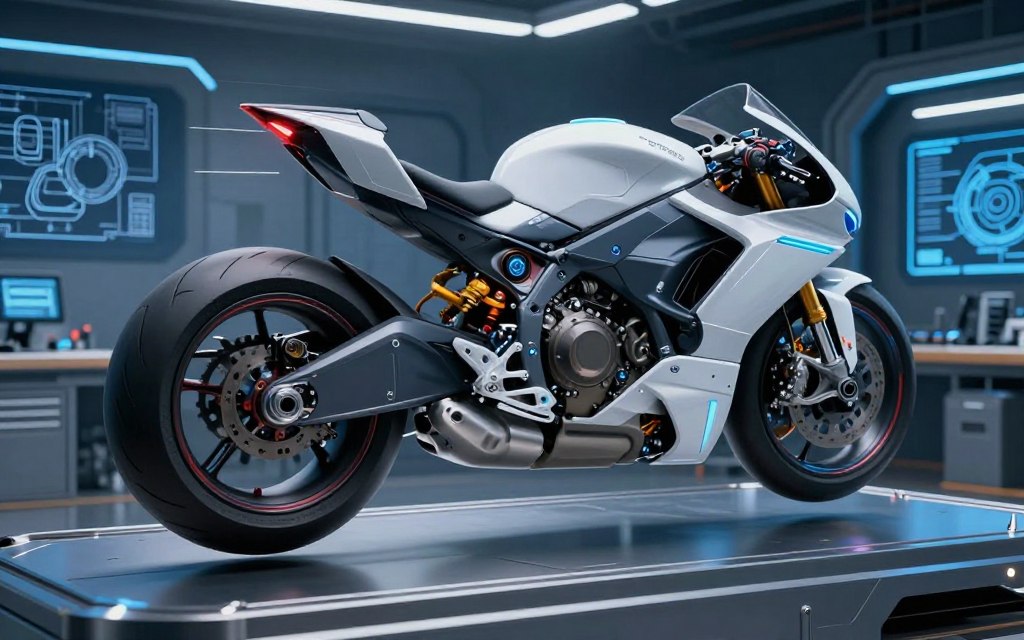
Early versions crashed hundreds of times. The challenge was getting the timing and small force adjustments right. The final system makes balance corrections up to 120 times a second. Some designs even have movable ballast for better low-speed stability.
Drive-by-Wire Throttle, Braking, and Steering
The AI needs direct control over the motorcycle’s main functions. This is done through a drive-by-wire system. Traditional mechanical links are replaced by electronic sensors and actuators.
The move was from simple servos to strong hydraulic actuators. These parts get digital signals from the AI and move the motorcycle physically.
- Throttle: An actuator controls fuel injection or motor power for smooth speed changes.
- Braking: Separate actuators control the front and rear brakes for better stability and weight distribution.
- Steering: A steering actuator makes the precise, fast movements needed for balance.
This setup gives the AI perfect control. It’s different from cars, which have stable platforms. The motorcycle’s system makes constant, small adjustments for survival, not just comfort.
| Control Function | Human Rider Method | AI Ghost Rider System | Key Engineering Advantage |
|---|---|---|---|
| Balance Correction | Instinctual body English & counter-steering | Algorithmic counter-steering at 80-120 Hz | Constant, measurable stability unaffected by fatigue |
| Steering Input | Handlebar torque and lean | Hydraulic steering actuator | Precise, repeatable movements for complex manoeuvres |
| Speed Management | Twist-grip throttle and lever brakes | Integrated drive-by-wire throttle/brake actuators | Perfect coordination for traction and weight transfer |
| Low-Speed Stability | Rider foot dabbing and balance | Gyroscopic precession & active ballast systems | Can hold a stand-still or crawl without human input |
Safety Architecture and System Redundancies
The AI Ghost Rider’s safety depends on a detailed safety plan. This plan is key for a motorcycle, where a single failure could be dangerous. It includes safety redundancies and strong protocols at every level.
Fail-Operational and Fail-Safe Protocols
Two main ideas guide the design: fail-operational and fail-safe. A fail-operational system keeps the motorcycle working even if something fails. A fail-safe system stops the vehicle safely if it detects a problem.
This mix is essential for dealing with unexpected situations. It needs a close link between hardware and software, always checking itself.
Redundant Sensor Arrays
Seeing the world is the first line of defence. The motorcycle has extra sensors like LiDAR, cameras, and radar. If one LiDAR fails, others quickly take over, keeping the 3D view intact.
This setup removes blind spots and keeps the AI’s view of the world accurate. It’s a key safety redundancy that protects against damage or obstacles.
Dual Computational Units
Handling sensor data needs strong, reliable computing. The Ghost Rider has two computing units that work together. One is the main controller, and the other checks its work.
If there’s a problem with the main unit, the backup can take over. This is vital for quick, safe actions, keeping the vehicle stable.
Cybersecurity Measures
The motorcycle’s digital connections make it vulnerable. Strong cybersecurity is as important as mechanical safety. It uses end-to-end encryption, intrusion detection, and updates to stay safe.
Regulations now require third-party cybersecurity checks. These tests make sure the vehicle’s software is secure against threats.
Keeping the AI safe from harm is essential. A complete safety plan must protect against both random failures and attacks.
Potential Applications and Use Cases
Any new tech is truly valuable when it changes our daily lives. The AI Ghost Rider is no exception. It aims to solve real-world problems in transport and future mobility. Its success will be seen in how it meets these needs.
Logistics and Last-Mile Delivery
Big cities face a big problem with delivery vans. They cause traffic jams and pollution. But, what if we used small, smart bikes for the last part of the delivery?
These bikes can get through tight spots that big vehicles can’t. They could be used all day, every day, for deliveries. This could make deliveries faster and cheaper.
Ride-Sharing and Mobility Services
In big cities, bikes are a key way to get around. Imagine a service where you can call a bike to pick you up. It would be cheap and easy to use.
This idea could also help with getting to public transport. You could ride a bike to the train station, then it goes to pick up someone else. It’s a smart way to use bikes without needing more cars.
Advanced Rider Assistance Systems (ARAS)
ARAS is a big deal because it helps riders stay safe. It uses AI to make riding a bike better. This is a huge help for those who ride bikes every day.
ARAS can do a lot:
- Enhanced Stability Control: The bike’s AI helps keep it steady, even on slippery roads.
- Collision Warning and Emergency Braking: It watches out for dangers and stops the bike if needed.
- Adaptive Cruise Control: It keeps a safe distance from cars in front, making long rides easier.
ARAS is a step towards making bikes safer. It’s a big step forward, even before we have fully self-driving bikes. This makes the tech very useful right now.
Technical Hurdles and Ethical Considerations
The idea of riderless two-wheelers faces big challenges. These include chaotic city streets, ethical questions, and a lack of rules. To move forward, we must tackle these problems. They mix advanced robotics, moral thinking, and law.
Navigating Complex Urban Environments
Handling the open road is one thing. But city traffic is much harder. An urban navigation challenge for a self-driving bike is huge. It must deal with people, bikes, erratic drivers, and roadworks.
Bad weather makes things even tougher. Rain, fog, and snow can mess up sensors. This means the bike’s AI needs to be very good at handling unclear data.
Engineer Anthony Levandowski says making a system for these conditions is hard. It’s about weighing complexity against usefulness and safety.
The bike’s AI must make quick decisions in places where rules aren’t clear. This is much harder than for a car.
The “Trolley Problem” on Two Wheels
The “trolley problem” is a big ethical issue for self-driving bikes. Unlike cars, bikes don’t have a safe space for riders. In a crash, how should the AI decide who to save?
Should it try to save everyone, even if it means the rider gets hurt? Or should it focus on the rider? These ethical considerations are real. They affect how the bike avoids crashes.
Public trust depends on these bikes being seen as having a moral compass.
Regulatory and Legal Frameworks
The law is trying to keep up with new tech. A clear regulatory framework is key for testing and use. Laws like Nevada’s SB-56 and California’s AB-2287 are starting to set rules for self-driving bikes.
These laws ask important questions. Who is responsible if something goes wrong—the maker, the programmer, or the owner? The regulatory framework must ensure safety for everyone.
Creating these laws is as tough as the engineering challenges. It needs global effort to make standards for safe use.
The Road Ahead: Future Developments and Evolution
Autonomous motorcycle tech is set to advance in two key areas: smart city infrastructure and AI. The next step is to link the vehicle with its surroundings. This creates a harmonious relationship between the machine and its environment.
Integration with Smart City Infrastructure
For true autonomy, motorcycles need to join the urban network. This smart city integration turns simple Vehicle-to-Everything (V2X) links into a smooth, predictive dialogue.
Imagine traffic lights telling us when they’ll change. Road sensors could warn of dangers far ahead. An autonomous motorcycle would adjust its speed and path for safety and smooth traffic flow.
This two-way communication enables dynamic lane management and priority for emergency vehicles. The motorcycle becomes a part of a city-wide mobility network, not just a solo rider.
Advances in AI and Machine Learning
The core intelligence of these machines is about to leap forward. Current systems rely on rules and sensor fusion. The future will bring experiential learning through AI advances.
Through reinforcement learning, the AI will learn from vast amounts of data. It could learn from MotoGP races, gaining advanced cornering skills. This shift will lead to more human-like decision-making.
The system will handle complex situations better. It will predict pedestrian actions more accurately and adapt to new urban layouts. These future developments could lead to new vehicle types, like ultra-compact pods for urban use.
| Aspect | Current State | Future Development |
|---|---|---|
| Perception | On-board sensors (LiDAR, cameras) create a local environment model. | Hybrid perception: on-board sensors fused with real-time city-wide data feeds (e.g., other vehicles’ sensor shares, infrastructure alerts). |
| Decision-Making | AI follows rules and reacts to immediate sensor input. | AI uses predictive algorithms and experiential learning to anticipate scenarios and plan smoother, more efficient routes. |
| Connectivity | Primarily V2V (Vehicle-to-Vehicle) for collision warnings. | Deep V2I (Vehicle-to-Infrastructure) integration, allowing negotiation with traffic systems and access to dynamic urban maps. |
| Vehicle Form | Modified traditional motorcycle frames. | New architectures optimised for autonomy, potentially smaller, lighter, and more specialised for logistics or personal mobility. |
Conclusion
The AI Ghost Rider project began as a curiosity from DARPA. It showed an autonomous motorcycle was possible. This machine could balance and move on its own, thanks to AI.
While we don’t have self-riding motorcycles for everyone yet, the tech is advancing. It’s making motorcycles safer with new systems. Companies like Yamaha, Honda, and Ducati are working on these ideas.
Anthony Levandowski played a key role in making this project work. His efforts showed it was possible. The project inspired many and showed us the challenges ahead.
Now, we see the practical uses of this technology. An autonomous motorcycle could change how we deliver goods. It could move through cities better than cars or vans.
In the end, the AI Ghost Rider was more than a stunt. It sparked real innovation. The journey to a self-driving bike is long, but it’s changing how we think about two-wheeled transport.
FAQ
Who created the first autonomous motorcycle?
Anthony Levandowski and his team at University of California, Berkeley, made the first autonomous motorcycle. They called it GhostRider. It was for the DARPA Grand Challenge in 2004.
How does an autonomous motorcycle stay balanced?
It uses algorithms and gyroscopic principles. The AI makes quick adjustments to the steering and throttle. This keeps the bike stable.
What are the main sensors used on an AI Ghost Rider?
It has many sensors. These include 360-degree LiDAR arrays, computer vision cameras, and radar. It also has ultrasonic sensors and IMUs for precise tracking.
What is V2X communication and why is it important for autonomous motorcycles?
V2X communication lets the motorcycle share data with other vehicles and traffic lights. It’s key for safety. It helps the bike show its presence and speed to others.
How is safety ensured in a riderless motorcycle?
Safety is ensured through a fail-operational design. It has redundant systems and cybersecurity measures. This protects against hacking.
What are the most likely real-world applications for this technology?
It’s useful for last-mile delivery in cities and for Advanced Rider Assistance Systems (ARAS). It could also be used in ride-sharing services.
What is the biggest technical challenge for autonomous motorcycles?
The biggest challenge is navigating urban traffic. Motorcycles need to balance at low speeds and handle unpredictable situations. The AI must make fast and accurate decisions.
Are there any laws governing autonomous motorcycle testing?
Yes, laws are changing. Nevada and California have laws for testing and safety. These laws cover two-wheelers, creating a new legal framework.
Which major motorcycle manufacturers are working on autonomous technology?
Yamaha, Honda, and Ducati are researching autonomous and advanced rider-assist technology. They aim to improve safety and develop future mobility solutions.
How will future AI improve autonomous motorcycle systems?
Future AI will learn from vast datasets of human rider behaviour. This includes MotoGP racing footage. It will lead to more intuitive and capable control systems.


 By
By



 By
By